

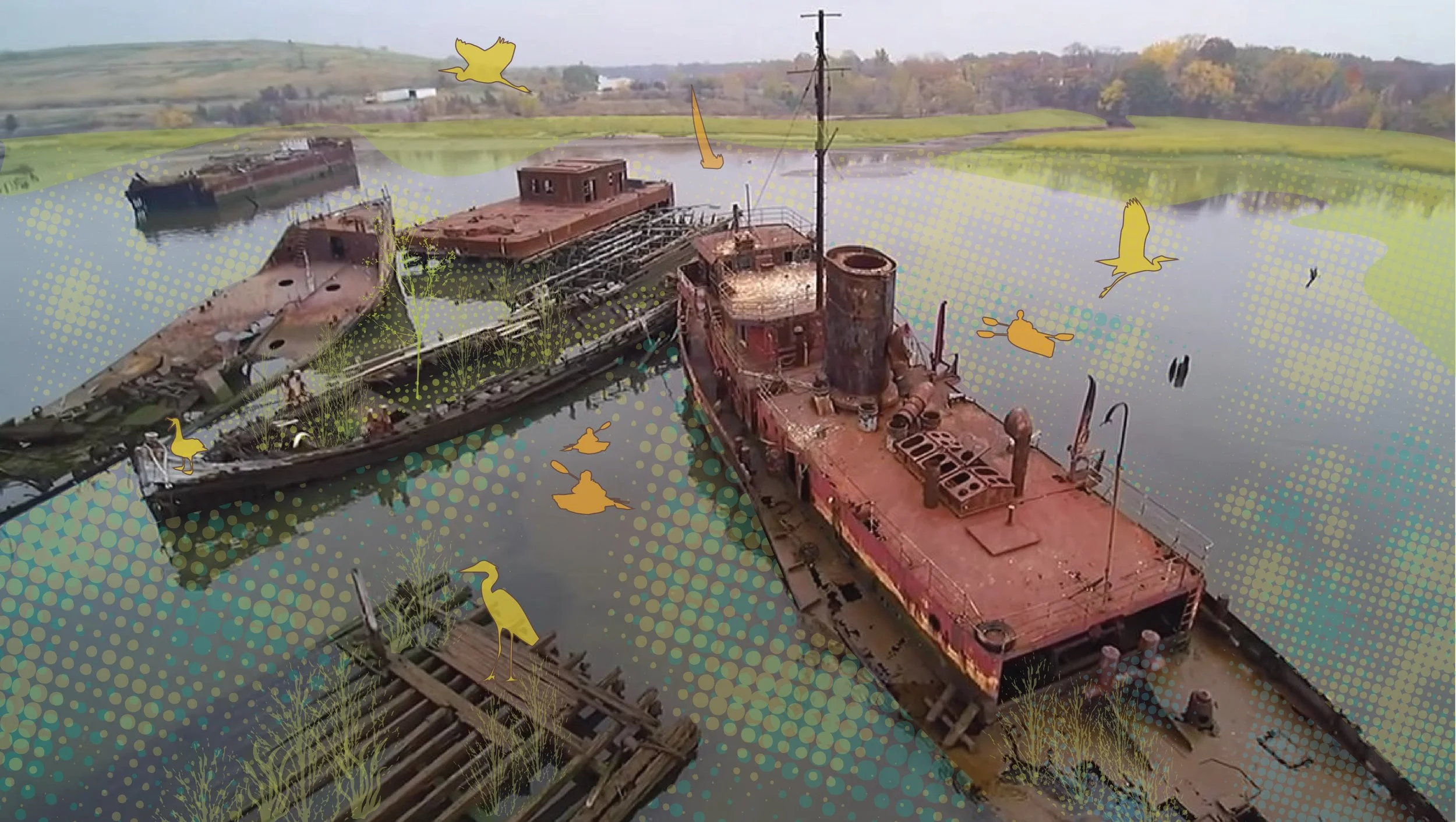
Could the pairing of a new waterfront park with an existing boat graveyard create a dual-layered defense against future storm surge on the west shore of Staten Island?
Boat graveyards are valuable evidence of our nation’s maritime legacy that could have an unexpected co-benefit as wave breaks during a storm. Also, after decades of disintegration, abandoned ships create habitat for aquatic species when they sink into their surrounding mudflat ecology. We could think of them as unintentional reef structures!
Floodable, absorbent, waterfront parks are the perfect secondary layer of defense against storm surge. Parks can be built to serve as a cushion for rising waters and waves, and parks are the best place to appreciate the grit and entropic beauty of a boat graveyard!
The resiliency strategy utilizes an existing boat graveyard as an “unintentional reef structure” that will help protect the park and the adjacent neighborhoods from coastal flooding.
Creating new access to a former industrial site unlocks much-needed public open space for Staten Island’s waterfront communities.
A new waterfront park paired with the existing ghost boat graveyard expands the recreational capacity of the waterfront for the adjacent community.
GHOST BOAT PARK
Pairing resiliency and ecology to protect shorelines that are vulnerable to storm surge

Location: Staten Island, New York
Client: Proposal for a park adjacent to a wind turbine facility
Services Provided: Site Planning, Visioning
Collaborators: MBM Estuary Strategies, TMS Waterfront